Sunrise and Night Kayaking in Cape Town Is It Allowed
Every paddler who visits the Atlantic coast asks some variation of the same question once the sun slips behind Lion's Head. You watch the water turn ink-black against the promenade streetlamps and wonder about night time kayaking out past the kelp line. The open ocean looks tranquil from the road. The city lights stretch along the foot of the mountain like a string of amber beads, and the idea of floating out there in the dead of night sounds incredible.
The reality is tangled up in South African maritime law, cold Benguela currents, and very strict commercial operating permits. People talk about sunrise kayaking and pitch-black ocean paddles in the same breath, but out on the water, dawn and midnight are two completely different beasts. If you want to paddle at first light or you are hoping to kayak at night along the Cape Peninsula, here is how the regulations, hazards, and real-world conditions actually shake out.
The Legal Reality of Night Kayaking Cape Town
South African Maritime Safety Authority regulations do not issue a flat, blanket ban on an individual owning a kayak and dropping it into public seawater after dark. If you own your boat and launch from a public slipway, nobody arrests you simply for putting plastic on water at 22:00. Commercial outfitters face an entirely different set of rules.
Commercial tour operators cannot legally take paying clients onto the open sea after civil twilight. SAMSA requires commercial paddlecraft operators to run daylight-only operations under their standard operating procedures. The moment the sun goes down, insurance policies lapse for guided groups. That is why you will not find a single legitimate outfitter in Sea Point or Hout Bay selling tickets to kayak at night across open ocean swells.
Note: Private paddlers taking to the open ocean after dark must carry an all-round white light visible for two nautical miles, an operable marine VHF radio, a whistle, and wear certified flotation with SOLAS reflective tape. Coast Guard patrols and harbor police can and will order you off the water if you lack required safety gear.
Then there is Table Bay harbor jurisdiction. Transnet National Ports Authority controls the waters stretching from Green Point right into the commercial docks. Paddling an unlit, low-profile craft through commercial shipping approaches or near harbor breakwaters after dark is a fast way to get intercepted by harbor security. The shipping lanes stay busy round the clock. A container ship moving at 14 knots cannot spot a sliver of rotomolded plastic in the dark, let alone turn around.
I spoke to a local sea rescue volunteer in Bakoven last year who put it bluntly. If you tip over at 21:00 three hundred meters off Saunders' Rocks without a light, search crews are essentially looking for an apple bobbing in a stadium parking lot with the lights switched off. The ocean here hovers around 11 to 13 degrees Celsius. Panic sets in fast, hypothermia follows within 45 minutes, and finding someone in the dark water is pure luck.
Book your kayaking cape town experience:
Why Sunrise Kayaking is the Better Bet
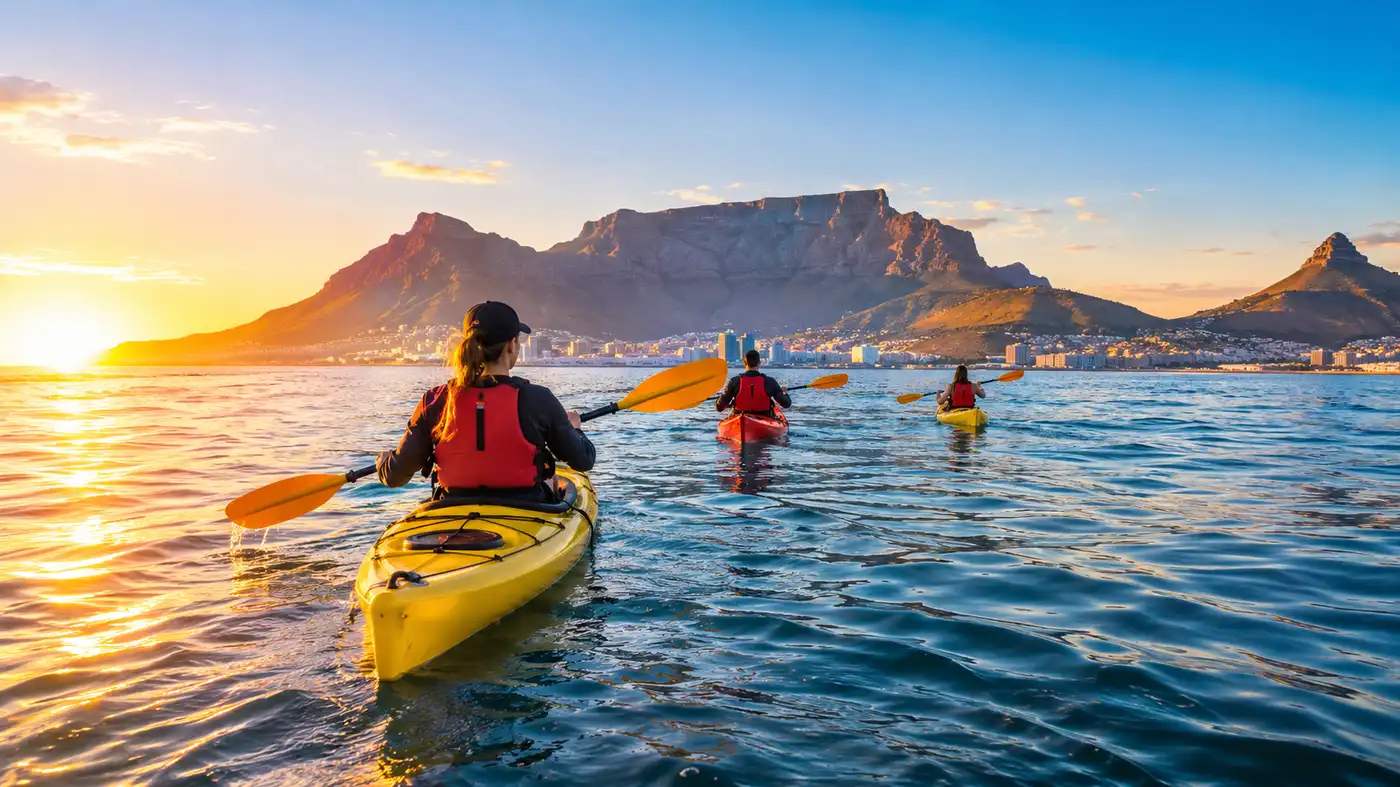
If you crave that surreal, empty-ocean feeling, sunrise kayak cape town trips offer everything people imagine night paddling to be, minus the flirtation with maritime disaster. Dawn on the Atlantic Seaboard is something special. The city behind you is dead quiet. You push off from the gravel at Three Anchor Bay around 05:45 in December, and the water is flatter than glass.
The meteorological reasons for this are straightforward. The infamous south-easterly wind, what locals call the Cape Doctor, tends to relax in the early hours of the morning before heating up over False Bay and picking up speed in the afternoon. Early morning gives you the calmest ocean surface you will see all day. When the swell drops below 1.5 meters, paddling past the Green Point lighthouse at first light feels almost effortless.
Commercial sunrise trips are fully legal and widely run between November and April. Because the launch happens during morning nautical twilight, the light builds steadily while you paddle. By the time you round the headland toward Mouille Point, the sun breaks over the spine of Table Mountain and Devil's Peak, bathing the sea in an intense orange glare. You get the dramatic mood of low-light paddling with the comfort of full visibility arriving thirty minutes later.
Pro tip: Book the very first launch slot of the morning, usually listed as 06:00. You will have to pull on a damp lifejacket in the pre-dawn chill, but it is the only time of day when you share the kelp beds with nobody but roosting cormorants and the occasional surfacing seal.
Conditions and Legal Limits: Dawn vs Sunset vs Night
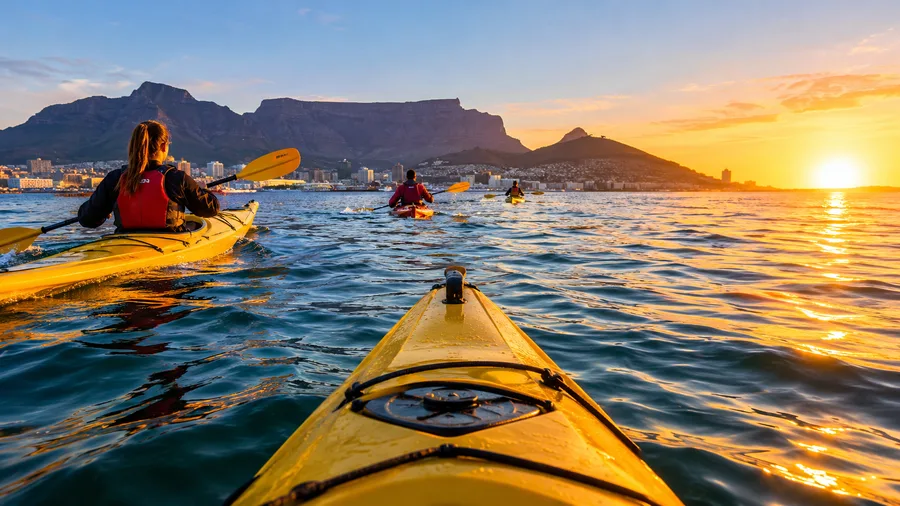
Understanding what is permitted and what is sensible requires looking at how light, wind, and oversight change across twenty-four hours. Here is how ocean outings compare across the key operational windows along the Peninsula.
| Time Window | Commercial Tours Allowed? | Typical Water Surface | Required Safety Gear | Primary Risk Factor |
|---|---|---|---|---|
| Sunrise (05:30 - 07:00) | Yes (Approved operators) | Glassy to low rolling swell | Standard PFD, whistle, guide radio | Rapidly shifting morning offshore breezes |
| Midday (10:00 - 14:00) | Yes | Moderate chop, wind chop building | Standard PFD, sun protection | Intense ultraviolet exposure, heavy tourist boat traffic |
| Sunset (18:00 - 19:30) | Yes (Must land before dark) | Mixed; often choppy from afternoon wind | Standard PFD, tracking by shore base | Losing light while returning against the wind |
| Night (After dark) | No (Prohibited for groups) | Variable, zero visual reference | All-round white light, VHF, flares, reflective strips | Commercial vessel collisions, invisible kelp entrapment |
If you want to know more about evening safety specifically, we wrote a detailed guide on sunset kayaking in Cape Town light wind safety that covers the tricky transition period right before dusk sets in. Understanding the interplay of wind and swell is essential reading before you commit to any low-light trip.
Book your kayaking cape town experience:
Can You Kayak at Night Anywhere Around the City?
While the open Atlantic is off-limits for guided tours in the dark, there are two distinct environments where night time kayaking occasionally happens under controlled, niche circumstances.
The protected V&A Waterfront canals offer an urban alternative. A few times each year, charity paddles or special club events organize illuminated night paddles through the canal system linking the V&A to the city center. You are paddling on quiet, controlled canal water with depth rarely exceeding two meters. There are no breaking waves, no offshore winds to sweep you toward Robben Island, and stone embankments sit three yards away on either side. It feels less like an oceanic adventure and more like a nocturnal city walk from water level.
The second option is the calm lagoon of Langebaan, about 90 minutes north of Cape Town inside the West Coast National Park. Experienced local sea kayakers sometimes organize private full moon paddles across Churchhaven. The water inside the lagoon is shielded from heavy ocean swell by the headland at Saldanha. Even there, currents rip through the mouth of the lagoon at spring tide. It is not an excursion for beginners who rented a sit-on-top kayak from an online classified ad.
If you are debating whether ocean paddling in this part of the world matches your current experience level, take a look at our breakdown on is kayaking in Cape Town safe weather currents skills before planning private twilight trips.
Practical Hazards of Paddling in the Dark
Most paddlers who dream of night outings picture glowing bioluminescence and peaceful solitude. Those things do exist on occasion, but the physical environment of the Cape coastline introduces serious problems the second your eyes lose natural daylight.
- Submerged bull kelp forests: Ecklonia maxima kelp fronds create dense underwater webs along Sea Point, Granger Bay, and Oudekraal. In daylight, you steer easily around the amber ribbons. In the dark, a paddle blade jams into a thick bulb, stopping your boat abruptly and flipping you into the water before you understand what caught you.
- Unlit reef ledges: Spots like Queens Beach and Mouille Point harbor shallow granite shelves that only reveal themselves when a swell suddenly peaks and breaks over them. Without horizon reference, judging where a wave is lifting becomes nearly impossible.
- Cape fur seal colonies: Seals are inquisitive animals by day. At night, their behavior changes as they hunt pelagic fish closer to the surface. A 250-kilo bull seal breaching without warning next to your cockpit in the pitch dark will give you an adrenaline spike you will not forget anytime soon.
- Cold water shock reflex: Falling into 12-degree water when you cannot see the horizon triggers involuntary gasping. Inhaling seawater in the dark quickly leads to disorientation, even if your personal flotation device brings you right back up.
Honestly, the sheer disorientation surprises people most. Without coastal landmarks to steer by, maintaining a straight heading out on the water requires constant compass checks. The city lights help if you are facing inland, but turning seaward leaves you staring into a black void where sky and water look identical.
What to Expect on a Morning Kayaking Sunrise Session
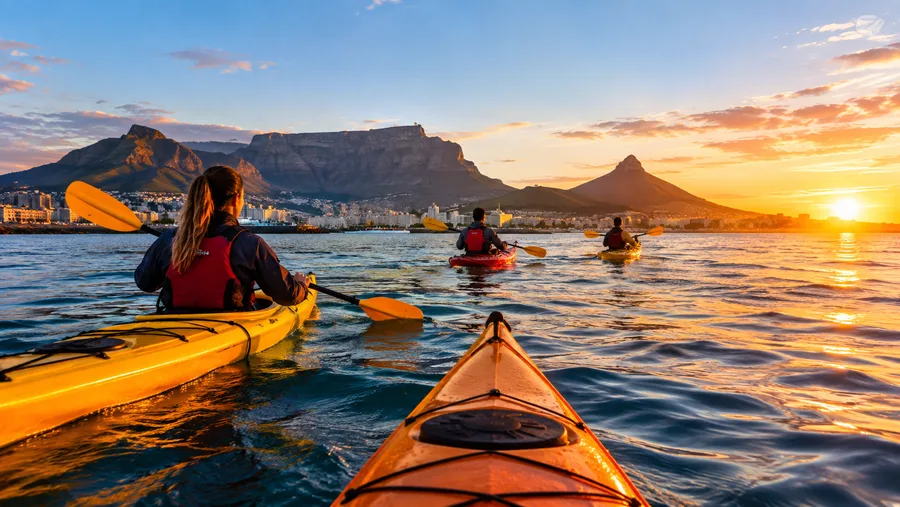
A dawn launch requires pulling yourself out of bed around 04:45, brewing a quick coffee, and driving down through the quiet streets to the Three Anchor Bay slipway. The municipal parking lot is usually empty except for a couple of dog walkers and the tour guides unloading double sit-on-top kayaks from a steel trailer.
The air temperature in midsummer sits around 16 degrees before sunrise, but the breeze coming off the bay has an icy edge. You pull on a windbreaker, step into the knee-deep wash, and climb onto the plastic seat. Pushing out past the tiny harbor gully, the sound of the city fades completely. You hear only the synchronized dip of fiberglass blades and water slapping against the bow.
- First twenty minutes: The sky shifts from deep indigo to purple-pink above Signal Hill, with lights on Lion's Head still blinking from early-bird hikers.
- Midway mark: The water around Granger Bay usually reveals pods of dusky or Heaviside's dolphins moving quietly parallel to the coast on their morning hunt.
- The sunrise moment: The sun bursts over the saddle between Devil's Peak and the main plateau, warming your face almost instantly and turning the Atlantic from steel-grey to bright turquoise.
- The return leg: You paddle back along the rocky shoreline, watching the Sea Point promenade come alive with joggers and outdoor gym groups as the clock hits 07:30.
You return to the beach with salt dried on your knuckles, plenty of time to grab breakfast at a beachfront cafe on Regent Road, and the entire day still ahead of you. It delivers all the romance that people look for in a night paddle, without the unnecessary peril.
Frequently Asked Questions about night time kayaking
Is night time kayaking legal anywhere in Cape Town?
Private paddlers may legally launch at night on open coastal waters if they carry full SAMSA-mandated safety gear including an all-round white light, VHF radio, flares, and reflective flotation. Commercial night tours on the open ocean are not permitted by maritime safety authorities.
Can I see bioluminescence while kayaking in Cape Town?
Bioluminescent dinoflagellates appear occasionally in False Bay and along the Atlantic Seaboard during late summer, usually following red tide blooms and warm days. Because commercial night paddling is prohibited on the ocean, catching this phenomenon from a kayak is rare and mostly limited to experienced private paddlers monitoring local algal conditions.
What time does a sunrise kayak tour launch?
Commercial sunrise trips typically meet at the launch site between 05:30 and 06:15 during summer months (November to March). Launch times adjust slightly later in spring and autumn as morning light shifts.
Quick Reference
- Commercial ocean night tours: prohibited
- Legal sunrise group launches: permitted year-round
- Average Atlantic water temperature: 11 to 14°C
- Required night gear for private paddlers: 2nm white light, VHF, flares
- Best launch location for sunrise: Three Anchor Bay
Book your kayaking cape town experience:
The Bottom Line
Resist the urge to rent a kayak and drag it down to the Atlantic Seaboard in the dark. The combination of black water, freezing currents, and invisible kelp turns a poetic idea into a dangerous situation before you realize you are in trouble. If you want that rare, peaceful stillness on the water, book a sunrise launch instead. You get the mirror-calm Atlantic, the mountain illuminated in gold, and you will be sitting safely in a beachfront coffee shop while the rest of the city is just waking up.
Read more about kayaking cape town.