Cape Town Kayaking What Makes This Destination Unique
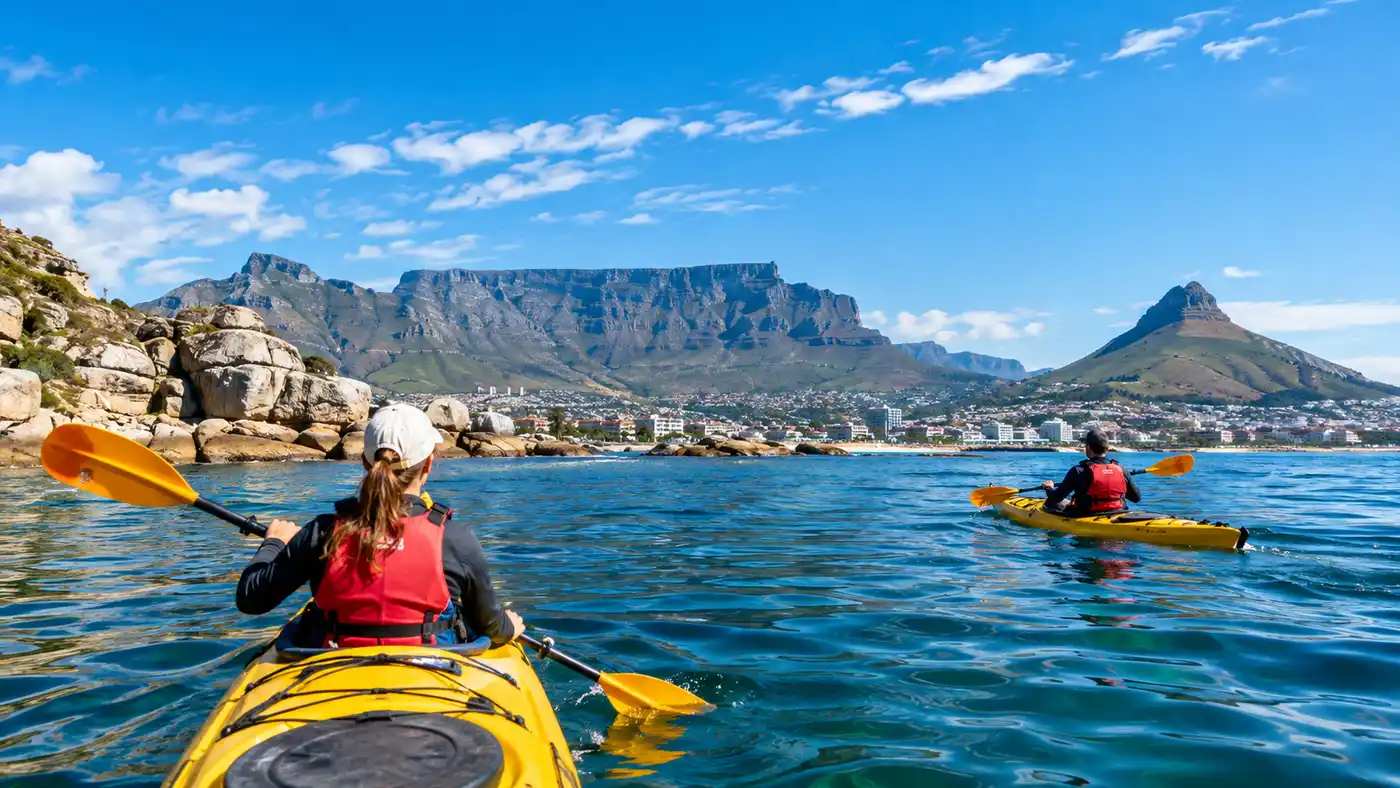
Most coastal cities keep their marine wilderness at arm's length, separated by concrete seawalls, shipping lanes, and miles of suburban sprawl. Cape Town does the opposite. You launch a plastic sit-on-top kayak from a tiny slipway behind an apartment block in Sea Point, and within five minutes you are floating over dense kelp forests with granite peaks towering a thousand meters above your head. When people ask about cape town kayaking what makes this destination unique, the answer usually starts with that immediate, jarring collision between an energetic modern city and genuinely wild ocean ecology.
You do not need to hike into remote backcountry or book a multi-day expedition to find world-class water here. A quick morning paddle lets you glide alongside endemic dolphin species, listen to the bark of Cape fur seals hauling out on offshore rocks, and watch the sun strike the granite face of Lion's Head. There are very few places on earth where you can finish a rugged coastal paddle and be sitting at an espresso bar twenty minutes later with salt drying on your skin.
Two Distinct Oceans on a Single Peninsula
The geography here is weird. The Cape Peninsula splits two massive marine ecosystems: the icy Atlantic Ocean along the western flank and the noticeably gentler, warmer waters of False Bay to the east. Paddlers who kayak in Cape Town rarely get just one kind of experience, because driving forty minutes south changes the entire dynamic of the water.
On the Atlantic Seaboard, the Benguela Current brings water straight up from the sub-Antarctic. It is cold. Even in midsummer, water temperatures sit around 11 to 14 degrees Celsius, which gives the sea an intense, emerald-green clarity. The ocean swells here travel across thousands of kilometers of open South Atlantic before crashing into the cliffs. To understand the raw power of this side, it helps to understand how Atlantic ocean conditions dictate your launch window, because when the swell picks up, the breaks are massive.
Cross over the mountain ridge toward False Bay, and everything softens. The Agulhas Current influences the bay, bumping water temperatures up to 18 or even 21 degrees on warm days. The coastline is sheltered from the prevailing westerly swells, making spots like Simon's Town far calmer and approachable for nervous beginners. You are essentially choosing between moody, dramatic ocean paddling on one side and relaxed coastal cruising on the other, all within the municipal boundaries of the same metro area.
Note: Water temperatures on the Atlantic side can plunge below 10 degrees Celsius after strong southeasterly winds trigger deep upwelling. Neoprene booties and a windbreaker are mandatory even on sunny, 30-degree summer afternoons.
Book your kayaking cape town experience:
Comparing the Primary Launch Regions
Because the coastline twists so sharply around the peninsula, each launch spot feels like a completely different journey. Having paddled all three main sectors multiple times, here is how the primary routes actually stack up against each other.
| Launch Location | Coastline / Ocean | Typical Water Temp | Primary Wildlife Sighting | Difficulty Level |
|---|---|---|---|---|
| Three Anchor Bay | Atlantic Seaboard | 11 - 14°C | Heaviside's dolphins, sunfish | Moderate (open ocean swell) |
| Simon's Town | False Bay | 16 - 20°C | African penguins, cormorants | Easy to Moderate |
| Hout Bay | Atlantic / Enclosed Bay | 12 - 15°C | Cape fur seals (Duiker Island) | Moderate (wind-funnel risk) |
If you want sheer convenience, Three Anchor Bay is unmatched. You pull up right along the Sea Point promenade, drop your gear, and paddle past the Mouille Point lighthouse. Simon's Town offers something entirely different. When you go kayaking in Simon's Town, you are navigating past naval vessels into sheltered coves where African penguins dive under your hull like feathered torpedoes.
Wildlife That Treats You as Part of the Scenery
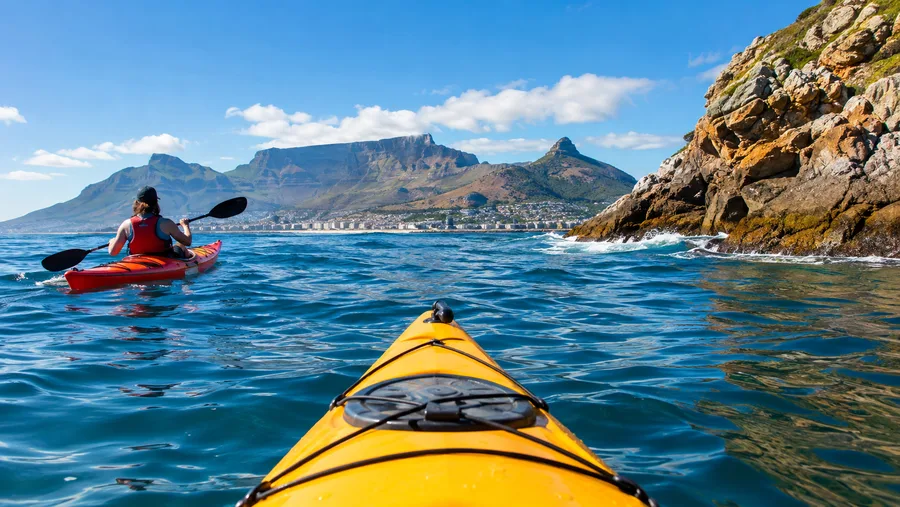
Kayaking Cape Town means you are at water level, moving silently. Marine animals here do not react to a kayak the way they react to a diesel engine. They are curious, occasionally indifferent, but rarely spooked.
One morning off Bantry Bay, about 300 meters offshore, three Heaviside's dolphins surfaced next to my bow. These dolphins are tiny, roughly 1.2 meters long, and they live only along the southwestern coast of Africa. They stayed with our small group for nearly 20 minutes, surfacing in synchronized arcs through the glassy swells. You cannot buy that kind of encounter on a commercial ferry, where you look down from five meters above the waterline through a pane of scratched safety glass.
The biodiversity packed into these coastal waters is astonishing:
- Heaviside's and dusky dolphins: Small, energetic pods that frequent the shallow surf zones along the Atlantic Seaboard, often surfing the wake of passing sea kayaks.
- Cape fur seals: Inquisitive, puppy-like animals that love rolling belly-up in the kelp fronds or darting directly under your rudder to inspect your boat.
- African penguins: Concentrated heavily around Simon's Town and Boulders Beach, frequently found rafting in small groups offshore between fishing dives.
- Ocean sunfish (Mola mola): Bizarre, prehistoric-looking creatures that drift near the surface during late summer, basking flat on their sides to warm up.
- Southern right whales: Giant seasonal visitors between June and November, often found lounging in the calm shallows of False Bay with their newborn calves.
A pod of seals playing around your paddle can be unnerving at first. They splash, slap the water with their flippers, and exhale with loud, wet snorts. But you quickly realize they are just playing. They treat sea kayaks like floating logs, weaving through the kelp stems without a care in the world.
Pro tip: Always look straight down through the water whenever you paddle across the kelp beds. Sunfish often drift three meters below your hull, and their giant silver silhouettes are easy to miss if you only scan the horizon.
Book your kayaking cape town experience:
The Towering Vertical Backdrop
Most coastal kayaking happens against flat horizons, low salt marshes, or distant sandy dunes. In Cape Town, you are paddling beneath massive sandstone massifs that rise straight out of the surf line.
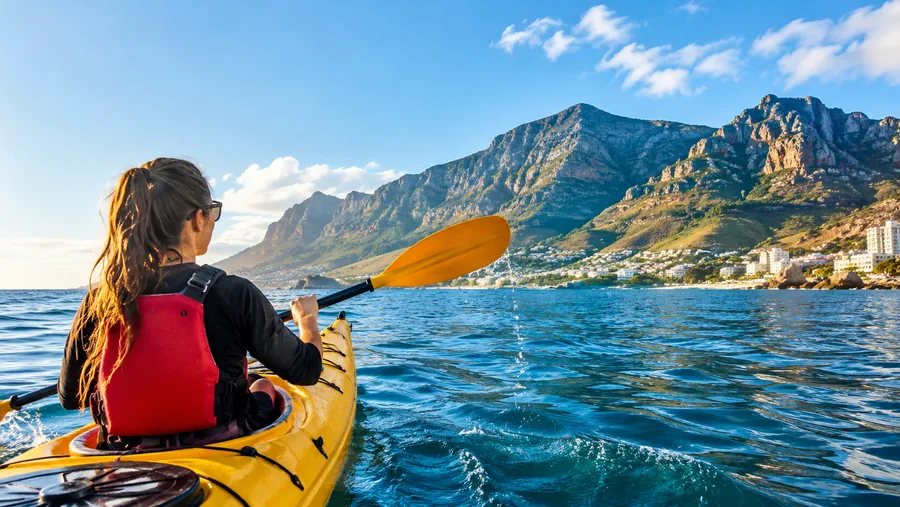
When you are sitting in a kayak off Clifton or Camps Bay, Table Mountain looks entirely different from how it appears from town. You see the sheer drop of the Twelve Apostles, a series of dramatic buttresses stacked one after the other down the spine of the peninsula. The rock faces catch the early morning light, turning shades of amber and rose while the water below remains in deep indigo shadow.
I think the sheer scale does something to your perspective. On land, the city feels busy, loud, and full of traffic. Out on the water, the traffic along Victoria Road becomes a silent line of tiny dots moving beneath sandstone crags. The city recedes into a thin strip of human habitation squeezed against the base of the mountains. It is a humble reminder of how tiny our settlements are against the raw African landscape.
Paddling around the point at Hout Bay toward the Sentinel brings another wave of drama. The Sentinel is a sheer 300-meter cliff of dark sandstone and granite that drops vertically into the churning sea. Paddling under its shadow, you hear the boom of the swell compressing inside sea caves deep in the rock. The acoustics out there are eerie and magnificent.
The Great African Seaforest
You cannot talk about cape town kayaking without mentioning the kelp. The waters around the peninsula are home to the Great African Seaforest, composed mostly of sea bamboo (Ecklonia maxima). These are not flimsy weeds. They are massive underwater trees with thick stipes and bulbous floats that can reach twelve meters in length.
To an inexperienced paddler, kelp can look intimidating. The fronds form thick golden mats across the surface, catching your paddle blades if your stroke is sloppy. But kelp is actually a paddler's greatest friend. It acts as a massive natural breakwater, deadening the chop and calming the ocean surface into smooth, glossy pathways.
Gliding through a kelp channel feels like paddling down an enchanted forest path. The stipes anchor into the granite bottom, swaying gently with the ocean surge. Beneath your boat, you can see anemones, sea urchins, klipfish, and small shy sharks swimming through the understory. On windy days, experienced paddlers head straight for the kelp beds because the thick fronds suppress whitecaps, creating sheltered lanes where paddling remains surprisingly easy.
Navigating Cape Town Weather Realities
Paddling here is spectacular, but the ocean does not tolerate complacency. The Cape of Storms earned its historic nickname honestly. Conditions can pivot on an hour's notice, transforming calm glassy coves into chaotic churn.
The primary weather maker during summer is the southeaster, locally known as the "Cape Doctor." It blows hard from False Bay over the mountain, funneling through valleys and whipping off the Atlantic coast. When the southeaster hits 25 knots, it pushes offshore along the Atlantic Seaboard, meaning an unwary paddler can get blown out toward open ocean with terrifying speed.
Smart paddlers use strict routines before putting a kayak in Cape Town waters:
- Check localized wind models: General city forecasts are useless; use marine wind apps like Windy or Windfinder that show gust speeds around mountain ridges.
- Launch early in the morning: Wind usually builds after 11:00 AM, so launching at 6:30 or 7:00 AM gives you the calmest water and best wildlife windows.
- Wear a high-visibility PFD: Low-slung kayaks are invisible to fast-moving motorboats and rescue craft amid Atlantic chop without a bright life vest.
- Carry an offshore communication tool: Keep your mobile phone in a certified waterproof case tied to your body, preloaded with the NSRI (National Sea Rescue Institute) emergency number.
- Know your bail-out beaches: Identify sandy haul-outs along your route ahead of time so you have an exit point if sea fog or wind rolls in abruptly.
Honestly, sea fog is the sneakier hazard. The Atlantic coast can be baking in sunshine at 9:00 AM, and by 9:45 AM a dense blanket of cold marine fog rolls in off the Benguela Current, dropping visibility to fifteen meters. If you do not have a compass or basic coastal navigation points, finding the slipway back at Three Anchor Bay becomes an exercise in anxiety. Stay close to the shoreline rocks if the fog bank creeps across the bay.
Frequently Asked Questions about cape town kayaking what makes this destination unique
What makes kayaking in Cape Town different from other ocean destinations?
The city sits at the meeting point of two major oceanic systems, bordered by sheer thousand-meter mountains. You can paddle alongside rare endemic wildlife like Heaviside's dolphins and African penguins within minutes of downtown, transitioning from calm bays to open Atlantic ocean swells in the same day.
Do I need sea kayaking experience to paddle in Cape Town?
Not necessarily. Guided tours in Simon's Town and Three Anchor Bay cater extensively to beginners, using stable sit-on-top plastic kayaks. However, independent paddlers tackling open Atlantic waters need solid self-rescue skills and strong knowledge of local wind patterns.
Are great white sharks a major concern for kayakers?
Shark sightings from kayaks are exceptionally rare. While white sharks and bronze whalers patrol regional waters, guided kayaking routes stay tight to rocky shorelines and kelp forests, which large predatory sharks naturally avoid. False Bay also operates a coastal Shark Spotters warning program.
Quick Reference
- Water temps range from 11°C (Atlantic) to 20°C (False Bay)
- Two distinct marine biomes across one small peninsula
- Heaviside's dolphins are endemic only to southwest Africa
- Thick sea bamboo kelp forests serve as natural wave dampeners
- Early morning launches (6:30 to 8:00 AM) offer the calmest conditions
Book your kayaking cape town experience:
Why You Need to Get on the Water
You can hike Table Mountain, drive around Chapman's Peak, and sip wine in Constantia, but you will only understand half of this city until you see it from the water. Out beyond the breakwater, the roar of the city traffic disappears, replaced by the rhythm of ocean swells and the sudden exhalation of a dolphin surfacing off your stern. Cape Town was built around maritime trade, but its true magic is how close that raw maritime wilderness remains to everyday life. Grab a paddle, put on a windbreaker, and get out past the breakers - there is nothing else quite like it on the continent.
Read more about kayaking cape town.